Threats and promise: A new reserve in Peru's Amazon
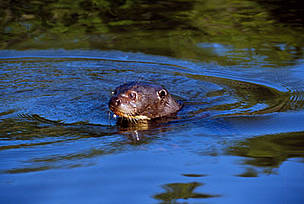
Giant river otter Pteronura brasiliensis.
But the reserve still faces numerous threats. Uncontrolled waves of immigrants, mostly from Peru's poverty-stricken Andean mountains, have put pressure on areas bordering the new reserve, clearing tracts of land for farming and human settlement, panning for gold with toxic mercury and over-fishing and hunting once plentiful species. Madre de Dios state, where the reserve is located, has just 75,000 people but nearly half this population is made-up of recent immigrants and their descendants and numbers continue to grow. Plans are afoot to build a "Transoceanic Highway" to join Sao Paulo in Brazil with a major city on Peru's Pacific coastline. The route is expected to include a derelict road that already runs close by the reserve's northern border. Improvements and extensions to this road would open the area to even more colonists.
A boom in tourism has also raised concerns. When properly designed, 'ecotourism' could provide a source of employment and jobs for locals while encouraging conservation of the reserve's natural resources. If left unchecked, however, an influx of resorts, motor boats and noisy tour groups could disturb highly sensitive and endangered species like the Giant River Otter.
These looming threats, exacerbated by scant government resources and personnel for protected areas, have made administration of the new reserve the real challenge.
"Sometimes in the North conservationists think you can put up a bar and keep everyone out of protected areas," says Fernando Rubio, director of INRENA, Peru's National Institute of Natural Resources, in Madre de Dios. This autonomous entity, nestled within the Ministry of Agriculture, is responsible for overseeing administration of the reserve. Rubio has spent most of his lengthy career working for non-government conservation groups and has learned that for protected areas to succeed, local communities must be involved in conservation efforts. The answer, he says, is working with locals to develop sustainable use of the forest's renewable resources. This concept is embedded in the government's definition of a reserve as "an area set aside for conservation and the sustainable use of wild flora and fauna." Land and water resources "can be commercialised as long as management plans are approved and supervised by the competent national authority."
Peru's conservation movement learned hard lessons in the 1990s when the government declared a 1.5 million hectare a transitory protected area. Named the Tambopata-Candamo Reserve Zone, the area included the now-Tambopata National Reserve. The idea was to protect this biodiverse area while questions of zoning were discussed. In one 5,500 hectare zone, for example, at the confluence of the Tambopata and La Torre rivers, scientists have logged world records of biodiversity: 545 bird species, 1,122 species of butterflies, 151 of dragonflies, 97 species of Asilidae family, 73 of horse-flies and 29 of tiger beetles.
In the haste to protect such threatened natural treasure, however, local people, including four indigenous communities and dozens of migrant settlements, were ignored. "The (Tambopata-Candamo) reserve was created without consulting local people. It's a vice that is always committed - each time isn't quite as bad as the last, but it still happens," admits Rubio.
Locals, represented by trade associations and indigenous groups, began voicing their discontent. The government called a series of public forums to try to calm tensions. But any goodwill that may have been earned was lost when the Peruvian government granted a concession to the Mobil Oil Corporation in 1996 to carry out explorations for natural gas in the Candamo valley.
Conservation groups opposed the concession and local communities accused the government of hypocrisy - banning locals from the Amazon in order to do business with large corporations. That same year, the Peruvian government decided the southern part of the Tambopata-Candamo Reserve Zone would become the Bahuaja Sonene National Park. This left the northern section of the transitory area; the most densely populated and hotly contested. A breakthrough occurred in 1999 when Mobil withdrew from the Candamo valley for economic reasons. Environmentalists celebrated but many locals remained bitter and suspicious of the government's actions.
Eventually an agreement was made leave local communities out of the reserve, creating a 272,000 hectare 'buffer zone' along the reserve's northern border - nearly the same size as the reserve itself.
Ultimately, Rubio thinks the buffer zone spells trouble for the same local communities it is meant to protect. If their lands had been included within the reserve, as originally intended, Rubio says locals would have had the legal right to use resources, following plans of 'sustainable use.' Instead, the buffer zone puts them at risk from an influx of new migrants who will compete for scarce natural resources.
In theory, natural resources inside the buffer zone should be carefully managed, explains Rubio, providing a cushion between the reserve and unprotected areas. "The entire planet should be considered a 'buffer zone,'" says Rubio. Without an effective management plan, however, there are no legal provisions to keep environmentally harmful activities out of the buffer zone, like panning for gold with mercury. But instead of calling for harsher laws, Rubio criticises his own department for failing to work with locals to develop greener forms of employment.
"You can't suddenly convince the population to follow new laws from one day to the next. If you don't win people over you will never be able to enforce the law," he says.
The problem comes back to one of trust and land ownership. Cesar Jo Ja Je, President of Sonene, an Ese 'eja indigenous community near Peru's border with Bolivia on the river Heath, fears the new reserve will restrict his village's growth.
"Right now we're not affected, but in the future our children and their children are going to need more land and they will be affected," says the young leader from his new municipal building - a palm leaf and bamboo structure overlooking an impressive virgin rainforest canopy of vibrant greens. Sonene has just 23 families but the 28 year-old president's face dissolves into mischievous laughter as he stresses that the community is definitely growing.
His good humour quickly evaporates when recounting how the Ese 'eja's lands once encompassed much of what is now the Tambopata National Reserve and the Bahuaja-Sonene National Park, the latter named after two Ese 'eja rivers. During Peru's agricultural reform, the Ese 'eja, like other indigenous peoples, were forced to accept small parcels of land. Today, the Ese 'eja remain divided into three small communities, numbering about 800 individuals in total, down from an estimated 15,000 at the beginning of the last century. Through FENAMAD, the Indigenous Federation of Madre de Dios, the Ese 'eja have been demanding recognition of their traditional lands.
Despite his reluctance about the reserve, Jo Ja Je is in favour of conserving the Amazon. His community works with Pro-Naturaleza, a Peruvian conservation group, on various sustainable use initiatives, including a turtle breeding program, and the village hopes to build and operate an ecotourism lodge with outside support. He blames colonists for environmental destruction of the Tambopata area and believes the surest way of preserving the forest is to grant legal title to indigenous groups.
Kleber Chavez is also deeply mistrustful of the government but for different reasons. His grandfather was a colonist who came to the Amazon from Peru's Andean mountain region. Although Kleber was born in the area surrounding the reserve about 40 years ago, he is considered a 'local' or a 'colonist'- classifications he says have been demonised by conservation groups. Rather than trying to keep locals out of the reserve, he thinks environmentalists should work with them to develop sustainable use activities, like ecotourism.
Besides the need to patch up relations with local and indigenous communities, administration of the reserve has been bogged down by bureaucratic wrangling. Although INRENA is charged with overseeing the reserve's management, several government agencies are involved in issues concerning their jurisdiction including mining and fishing ministries, the Peruvian navy and Ecological Police. When problems arise, there are often internal arguments about who should respond.
Budget constraints further impede INRENA's work. With support from an array of non-government groups like WWF, Conservation International and Pro-Naturalise, INRENA has been able to maintain and staff five park ranger posts at strategic points inside the reserve. But with a maximum of two staff members on duty at each post, the park rangers feel like Band-Aids applied to a gaping wound. The active role conservation groups have had to play to keep INRENA afloat has added further complications - many locals accuse environmental groups of buying government interest and having too much say in policy matters.
In an attempt to bring the various warring factions together to plan a common future for the reserve, a private-sector management committee was formed this year with members from major interest groups. Although the government has the final word, the committee will submit proposals on regulations and management and interpret laws and propose new ones.
Cesar Ascorra, president of the committee and a biologist with Conservation International, says his main hope "is that we can learn to understand one another." This is no small task when considering the array of participants - from a gold miners' association to tourism lodge owners to environmentalists to representatives of indigenous groups.
After 15 years experience working in the Amazon, the quiet but well-spoken biologist sighs heavily when discussing the difficulties facing the committee. But Ascorra agreed to take on the meditative role of president because he believes that for the reserve to succeed, management plans "must be economically viable, socially compatible and ecologically sustainable." A tall but necessary order and one that is shaping up to be an even longer and more complicated struggle than the creation of the reserve.
Stephanie Boyd is a freelance journalist commissioned by the WWF Forests for Life Programme.
Giant river otter Pteronura brasiliensis.
Related links
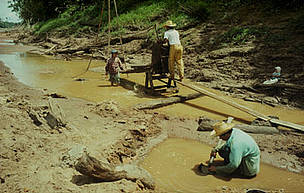
Small scale alluvial gold mining in sand at river side Tambopata-Candamo Reserved Zone, Peru.
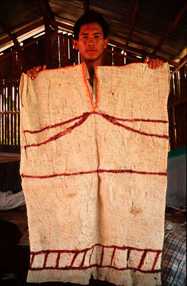
Ese 'eja Sonene President Cesar Jo Ja Je Erinex shows off his traditional dress.